Prikry forcing singularizes a measurable cardinal using a single normal measure on . Radin forcing replaces this single measure by a long sequence of measures on , all derived from one elementary embedding. The generic object will then be a sequence of points of — ordinals and smaller measure sequences — whose first coordinates form a closed unbounded subset of . In this chapter we develop the notion of a measure sequence and isolate the class from which the forcing conditions will be drawn.
We follow the concrete approach due to Woodin, as presented in Gitik’s chapter of the Handbook.
Notation.
Throughout these notes we follow the notation of Gitik, Prikry-Type Forcings (Handbook of Set Theory, Ch. 16, §5.1), which will be our default setting. We keep Cummings’ terms weak measure sequence and constructing embedding, which Gitik uses only implicitly.
1.1 Measure sequences derived from an embedding
Definition 1.1.1
Let be an elementary embedding into a transitive inner model with . Define a sequence by recursion on :
- , the normal ultrafilter over derived from ; it concentrates on ordinals and is nothing but the usual derived normal measure on , viewed as a measure on ;
- if , then
- the length is the least such that .
We call and its initial segments -sequences of ultrafilters. Note that all the are ultrafilters on the same underlying set ; this uniformity will be essential once measures from different levels of a sequence meet inside a single forcing condition.
Exercise 1.1.2
Show that for every , is a -complete ultrafilter over (for it concentrates on ordinals).
1.2 Weak measure sequences
For the measures do not concentrate on ordinals but on sequences resembling initial segments of itself.
Definition 1.2.1
A sequence is a weak measure sequence (wms) iff
- is an inaccessible cardinal;
- every is a measure on ;
- is normal and concentrates on ordinals.
We write for the first coordinate of .
Note: a weak measure sequence is, literally, merely a sequence of measures. The only constraints are that all of its measures live on the same underlying set , and that is normal and concentrates on ordinals.
Exercise 1.2.2
Show that for every with , concentrates on weak measure sequences, i.e. In particular concentrates on pairs with measurable below and a normal ultrafilter over . (Hint: work in and check that is itself a wms.)
1.3 Normality
The measures are normal in the following sense, which is the form of diagonal intersection appropriate for sequences rather than ordinals.
Definition 1.3.1
Let be a family of sets of weak measure sequences. Their diagonal intersection is
Exercise 1.3.2 (Normality).
If for every , then . (Hint: show , using that fixes pointwise.)
1.4 The hierarchy
Definition 1.4.1
A weak measure sequence is a measure sequence if it is a -sequence of ultrafilters for some embedding with ; such a is called a constructing embedding for .
Not every measure sequence is suitable as a building block for the forcing: we want sequences whose measures concentrate on sequences of the same kind. This is achieved by the following hierarchy.
Definition 1.4.2
Define by recursion on :
- ;
- ;
- .
Exercise 1.4.3
Show that if , then every measure on concentrates on , i.e. for all . (Use countable completeness of the measures.)
Definition 1.4.4
For a sequence , let If , i.e. , we set by convention.
Exercise 1.4.5
Show that is a -complete filter whenever .
The next lemma is what will make one-step extensions of the Radin forcing legitimate: if and , then is addable to .
Lemma 1.4.6
Let and . Then
Proof. Let be a constructing embedding for and fix ; we show . For : concentrates on ordinals, every ordinal passes the defining condition of vacuously, and since ; hence , i.e. .
Now let ; we show . By elementarity, is computed in by the same formula, so we need:
- : this is exactly .
- : since fixes pointwise, , and for every ; by upward closure for all such .
Hence , as required.
1.5 Long measure sequences
Radin forcing with a sequence of length will change the cofinality of to , so applications require long measure sequences in . The following lemma of Cummings and Woodin shows that a moderately strong embedding already provides sequences of length .
Lemma 1.5.1 (Gitik, Lemma 5.1).
Let be a -extender and the corresponding elementary embedding, so that and . Let be the -sequence of ultrafilters of the maximal length. Then (a) ; (b) for every , .
Proof. (a) We claim for every . Given , work in : since , computes and correctly, so there is a bijection in . Then is (coded by) a subset of , hence , and . Since each , the sequence is (coded by) an element of . Thus the recursion defining does not break down before .
(b) We show for all and all .
Step 1: . We must show that for every with . By the definition of this means: in , , i.e. contains an embedding constructing .
Fix with . We choose the truncation of according to the size of :
- Case 1: . Let .
- Case 2: . The truncation is now trivial: since fixes every , each of its measures is principal, so and the associated embedding is the identity — which cannot be a constructing embedding for anything. We therefore truncate further out and set .
In both cases is nontrivial: its fragment at is exactly (this is precisely why Case 2 requires the longer truncation). Moreover is coded by a -sequence of elements of , and , so part (a) gives . Let , let be the factor map with , and let , where (the identification uses ). Note that , so is a legitimate candidate for a constructing embedding.
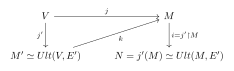
We record the standard properties of the factor map: and (note since ). In particular .
Claim. for every measure on .
Proof of Claim. Since , fixes pointwise, so . Both are ultrafilters on , and , so by maximality of as a filter, .
Now let be the -sequence of ultrafilters constructed in . We show by induction on that . Suppose . For (note ):
Hence in , is the -sequence, so , as required.
Step 2: a general observation. The following agreement holds for any elementary embedding with — no closure hypothesis on is needed: Indeed, gives . For we have the chain of equivalences For the first equivalence: given any constructing embedding for — with and — the -extender derived from lies in (since is inaccessible) and constructs the same sequence; the converse is trivial. For the second equivalence: the assertion ” constructs ” is absolute between and , since it unfolds into a recursion of length whose parameters and intermediate objects all lie in , which and compute identically.
Remark. This agreement is a general fact about embeddings with critical point , not a feature of the particular embedding at hand. Gitik’s own wording at this point is somewhat misleading: he argues from the specifics of his , and his appeal to “the same argument” for the iterates is only justified once the general observation is isolated — every has critical point , so Step 2 applies to each of them verbatim.
Step 3: for . Inductively, iff for all , , iff for all , . Unwinding once more, this reduces to the agreement of Step 2 together with Step 1. For larger the same argument is applied with replaced by the iterated ultrapower embedding of by ; since , Step 2 yields directly.
Remark. Using stronger embeddings it is possible to show that much longer ultrafilter sequences belong to . For the basic theory of Radin forcing, length is more than sufficient.
1.6 Mitchell order 2 is not enough: μ-measurability
Before moving on, let us see what the construction of Section 1.1 produces in the simplest nontrivial large cardinal situation, and isolate exactly the hypothesis needed to go further.
Suppose , and let be normal measures on witnessing this: , and no normal measure on has Mitchell order . By fixing a wellordering , we may redefine both and as normal measures over . Let be the ultrapower embedding, and let be the -sequence of ultrafilters of Definition 1.1.1.
Example 1.6.1 (The -sequence).
(a) : by definition, . (b) : to continue the recursion at we would need . But by the standard fact that for every normal measure (otherwise , contradicting the well-foundedness of the Mitchell order). Hence the recursion breaks down immediately, and the maximal -sequence is just . (c) Consequently, Radin forcing with will be nothing but Prikry forcing with (the case of the next chapter). (d) : it belongs to by construction, and since , the requirement ” for all ” in Definition 1.4.2 is vacuous. Hence for every , and so . This is Gitik’s remark that every measurable cardinal is in .
What concentrates on. Although its own derived sequence is short, does “see” measure sequences below : since and , ” is measurable”, so by Łoś and each such is the first coordinate of a measure sequence . This is the shadow of the case : were there a next measure , it would concentrate on pairs with a normal measure on (cf. Exercise 1.2.2).
The exact obstruction. The obstruction in (b) is general: for the derived normal measure is itself, and , so the ultrapower by a single normal measure always yields a sequence of length . Looking at the recursion of Definition 1.1.1, continuation past requires exactly one thing: i.e. the embedding must “re-absorb” its own derived normal measure. This property has a name.
Definition 1.6.3.
A cardinal is μ-measurable if there is an elementary embedding with such that the derived normal measure belongs to .
Equivalently, is μ-measurable iff there is an embedding whose derived sequence of ultrafilters has length . Thus μ-measurability is exactly the hypothesis needed for a nontrivial Radin forcing: with the forcing already produces generic sequences of type (the case of the next chapter).
Several comments are in order.
μ-measurability requires genuine extenders. No ultrapower by a normal measure can witness μ-measurability, since ; a witnessing embedding must therefore come from an extender which is not equivalent to a normal ultrafilter. In fact, μ-measurability is the weakest large cardinal property which requires the existence of extenders which are not equivalent to normal ultrafilters: its defining clause "" is the minimal closure requirement beyond a plain ultrapower — the first rung at which the recursion of Definition 1.1.1 produces anything beyond a normal measure.
μ-measurable implies . If witnesses μ-measurability, then , and one checks that ” is a normal measure on ” (every is split by , and -completeness and normality are computed using objects that remain in ). Hence ” is measurable”, which by the definition of means so and . The hypothesis of Example 1.6.1 is therefore strictly weaker than μ-measurability.
Consistency strength. We state without proof that the consistency strength of a μ-measurable cardinal lies strictly between that of a measurable cardinal and that of a -strong cardinal: The upper bound is immediate: if witnesses that is -strong, then , hence . This is precisely the hypothesis of Lemma 1.5.1, which therefore produces sequences of length — far more than the length that μ-measurability barely provides.
Exercise 1.6.2.
Show that , i.e. does not believe that is a measure sequence. (Hint: a constructing embedding for it inside would in particular yield .) Conclude once more that the recursion of Definition 1.1.1 stops at .
Exercise 1.6.4.
Let witness that is μ-measurable, and let be the second measure of the derived sequence. Show that concentrates on pairs with measurable and a normal measure on . (Hint: in , is such a pair.)
Notes
The forcing was originally defined axiomatically by Radin [48] and Mitchell, abstracting the properties a sequence of measures must satisfy; the concrete construction from a single embedding used here is due to Woodin. Lemma 1.5.1 is Lemma 5.1 of Gitik’s chapter, where it is credited to Cummings–Woodin [10]. The class will reappear as the reservoir from which all measure-one sets in the Radin forcing are taken: in Definition 5.2 of Gitik’s chapter, conditions have the form with and .
References
Main reference:
- Moti Gitik. Prikry-type forcings. In Matthew Foreman and Akihiro Kanamori, editors, Handbook of Set Theory, pages 1351–1447. Springer, Dordrecht, 2010.
Numbering below follows the bibliography of Gitik’s chapter:
- [10] James Cummings and W. Hugh Woodin. A book on Radin forcing. In preparation.
- [48] Lon B. Radin. Adding closed cofinal sequences to large cardinals. Annals of Mathematical Logic, 22(3):243–261, 1982.